
The other day on Mercari, I came across an unopened Famicom copy of Ultima IV: Quest of the Avatar.
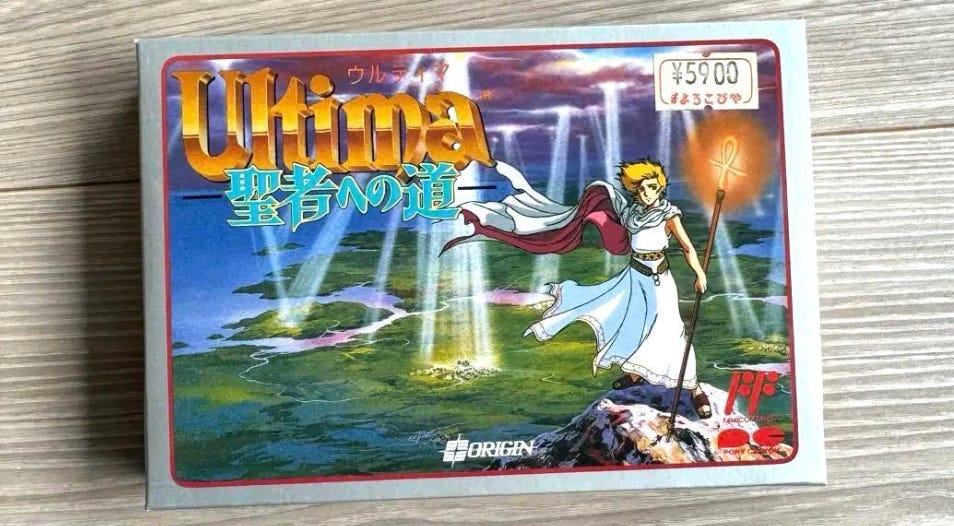
While it remains a legendary title among hardcore retro fans, its household recognition in Japan never quite matched the monumental status of Dragon Quest.
Whenever I see this cartridge, a bizarre historical mix-up immediately comes to mind: there was a time when Ultima was presented to the general public as a Dragon Quest copycat.
Gamers today would probably find that baffling. After all, it is well documented that Dragon Quest was the one shaped by western computer RPG pioneers like Ultima and Wizardry.
Back then, I regularly read PC magazines, so I was fully aware that Ultima had existed long before Dragon Quest was even conceived. In fact, I had already bought and played the Famicom port of Ultima myself. Then one day, I was completely caught off guard by a gaming feature inside a weekly tabloid. Right there in print, Ultima was framed as a title heavily inspired by Dragon Quest.
The description felt wrong—and chronologically, it was completely backwards.
What truly surprised me, however, came later. When the sequel, Ultima IV: Quest of the Avatar, arrived on the Famicom, the exact same magazine doubled down, writing that “just like its predecessor, it takes cues from Dragon Quest, but adds its own unique touches.”
It wasn’t a one-off editorial slip. The foundational progenitor of the entire genre had been officially framed as a derivative knockoff.
At the time, rather than feeling annoyed, I was struck by a completely different realization: the sheer cultural gravity of Dragon Quest was so massive that it warped mainstream perception.
Anyone who actually played both series knew how fundamentally different they were. Having spent hours with each, the gameplay contrasts were obvious to me.
In the pre-internet era, however, access to information was extremely limited. It only makes sense that a writer unfamiliar with computer gaming, looking at a few screenshots of an overworld or characters talking to townspeople, concluded it was just “another game like Dragon Quest.” The misunderstanding was less about ignorance of game mechanics and more of a cultural symptom unique to the old-media era.
Gaming magazines at the time regularly acknowledged that Dragon Quest drew its DNA from Ultima and Wizardry, and dedicated enthusiasts understood that lineage well. But for general-interest tabloids, their writers, and their readers, things were completely different. For the general public, the very definition of an RPG was Dragon Quest.
Encountering a game with towns, an overworld, and command-driven exploration, people naturally thought, “This looks like Dragon Quest.” Reality and perception had flipped entirely.
Today, a quick internet search clears up the chronology in seconds. But back then, dedicated game publications and general print media operated in completely different information realities. That gap is precisely why a founding pillar of the RPG genre ended up being reported as a follower of the very phenomenon it helped inspire.
And today, looking at this pristine copy of Ultima IV, the atmosphere of that era comes rushing back long before thoughts of the actual gameplay.
Listing Breakdown
Item Link: https://buyee.jp/mercari/item/m64093546386
Price: ¥6,600 (approx. $44 USD)
Condition: Brand New / Unopened (Deadstock copy in original cardboard packaging)
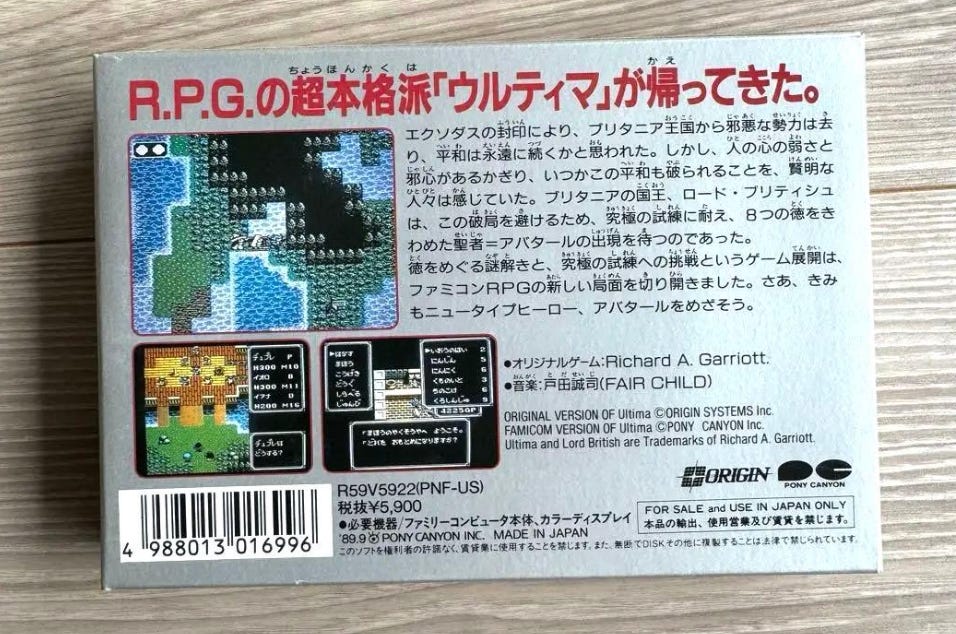
Unlike CD-based jewel cases, Famicom cardboard boxes rarely came with outer factory shrink-wrap.
However, examining the photos of this specific listing reveals no signs of stress around the box edges and opening flaps. Furthermore, Ultima did not command the runaway mainstream popularity of Dragon Quest in Japan, making it very plausible that this unit simply sat forgotten in distributor deadstock for decades.
While it is impossible to certify 100% untouched status from photos alone, the box presentation carries strong credibility, especially when framed against its commercial history.
More importantly, this cartridge isn’t just a piece of vintage software. It is a preserved time capsule from an era when the RPG genre was still largely misunderstood by mainstream culture, and Dragon Quest stood as the absolute benchmark against which all interactive fantasy was measured.
Looking back now, even that mistaken tabloid review feels like a valuable historical artifact. By being so blatantly wrong, it reveals exactly what mainstream audiences knew, and didn’t know. This unopened copy of Ultima IV preserves not just the cartridge, but a snapshot of that inverted media history.
Written by Keida | Translated by Lotus
[Market Reality Note] The artifacts featured in our reports are live, highly volatile listings sourced directly from the Japanese domestic secondary market. Due to the underground nature of these collector ecosystems, items may sell out or be removed by the seller at any given moment. Consider each report a real-time window into a vanishing opportunity.
Request Our Premium VIP Hunting Service for Ultra-Rare Vintage Items:
The artifacts exist. The mud is deep.
If you seek a specific Holy Grail in the Japanese underground market and demand our uncompromising vetting process, this private dispatch is available.