
A Dig That Started With a Strategy Guide
Whenever I have spare time, I browse Mercari’s “Books / Games & Strategy Guides” section.
I am rarely hunting for a specific title. Mostly, I browse because you never know when you will stumble across a guide you didn’t even know existed, or a gaming magazine you forgot about years ago.
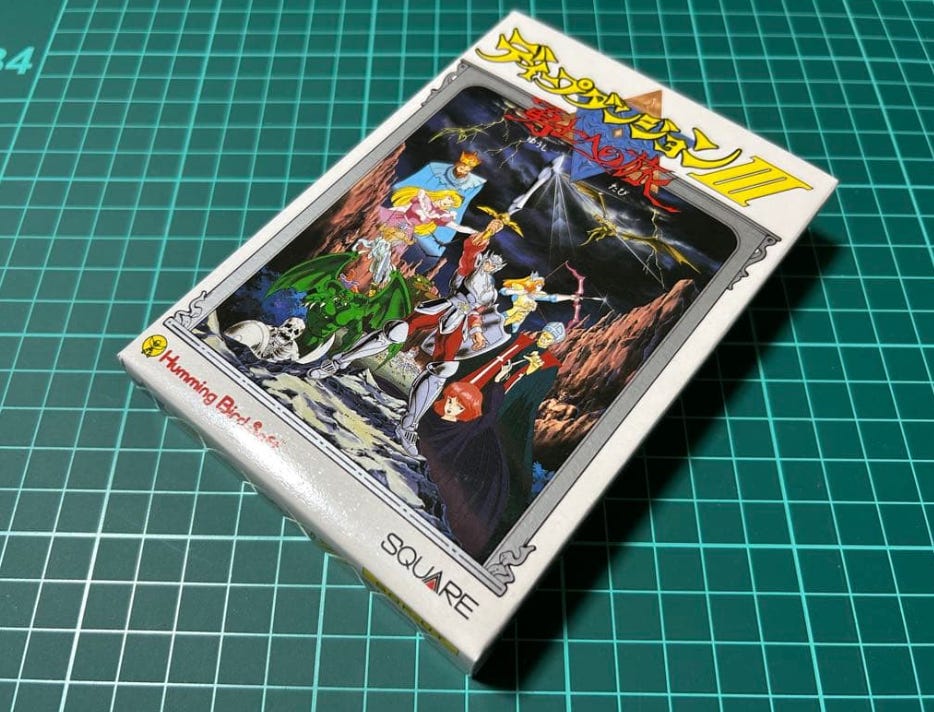
During one of these routine digs, a single cover caught my eye: Tokuma Shoten’s complete strategy guide for Deep Dungeon III: The Journey to the Hero.
Seeing that cover immediately pulled me back more than 30 years to a specific memory at a local toy shop. Curious, I decided to search Mercari for the Famicom cartridge itself—and ended up finding a brand-new copy.
The Game I Never Planned to Buy
I loved the first two Deep Dungeon games, so I was naturally curious when the third entry came out. However, because the developers had overhauled the game mechanics, I decided to read magazine reviews before buying.
The reviews were rough. Apparently, the combat balance was brutal, the maps were massive, and reaching the ending without a strategy guide was nearly impossible. After reading those warnings, I decided to pass.
Then one day, I spotted a copy of Deep Dungeon III at a local toy store I occasionally visited. There, sitting right next to it, was the official strategy guide.
Back in those days, seeing a game and its strategy guide displayed side-by-side at retail was completely normal. Nobody forced you to buy both, of course, but if you felt you needed the extra help, you could grab them together on the spot.
That shop sold games at full MSRP. If I had gone to a big-box discount retailer, I might have saved a few hundred yen. But there was no guarantee they would have the guide in stock, and ordering one could easily take two to three weeks.
This was long before the internet made looking up walkthroughs effortless. Standing there staring at the guide propped up beside the cartridge, I figured that with the book in hand, I might actually be able to beat it.
Minutes later, I impulse-bought both the game I had sworn off and its companion guide.
Without That Guide, I Might Have Given Up
Once I booted it up, I quickly understood the reason behind its infamous reputation.
The level grinding, in particular, was brutal. In a typical RPG, if a boss is too tough, you drop back to fight weaker enemies and grind out some experience. In Deep Dungeon III, however, once your party gets stronger, weaker enemies actively avoid you.
You couldn’t farm battles on earlier floors, and stepping onto the next floor meant facing overwhelming monsters. Even trying to grind XP meant one bad roll could wipe your entire party in seconds. That was just how the game was built.
Owning the strategy guide didn’t magically fix the combat balance. Even so, I somehow managed to reach the ending. The most helpful part was the maps included in the guide—navigating those sprawling dungeons without printed maps would have been a nightmare. Without that guide sitting next to me, I probably would have given up halfway through.
Owning the strategy guide didn’t magically fix the combat balance. Still, the printed maps inside were a lifesaver. Navigating those sprawling dungeons without them would have been a nightmare. Without that guide sitting next to me, I probably would have given up halfway through. Thanks to it, I somehow managed to reach the ending.
Unfortunately, my overall verdict on the game itself stayed low right up to the credits. Still, playing through it and forming my own opinion felt rewarding. Buying the guide was definitely the right call.
The Era When Guidebooks Sold Games
Today, anyone can look up walkthroughs or maps online in seconds, and the role of strategy guides has changed completely.
Back then, a guide was more than just a reference manual. It had the power to convince hesitant shoppers that a notoriously tough game was actually beatable. That is the exact reason I walked out of that toy store with Deep Dungeon III.
Looking at the brand-new copy I stumbled across on Mercari today, I couldn’t help thinking about that. According to the seller, this cartridge was stored inside a master shipping carton. If it truly is unsold retail deadstock from the late 1980s, it makes you wonder: had it been displayed next to a strategy guide like the copy at my local shop, would someone have picked it up back then? Of course, there is no way to know the exact path this box took to stay sealed for over three decades.
What I do know is that a strategy guide convinced at least one kid more than 30 years ago to take a chance on it—and made it possible for me to play it all the way to the end.
Listing Breakdown & Analysis
Item Link: https://buyee.jp/mercari/item/m10342236962
Price: ¥7,999 (approx. $52 USD)
Condition: Brand New / Unopened (Carton-stored deadstock)
Notes: Outer cardboard box retains crisp color with minimal fading, corner wear, or crushing visible in photos.
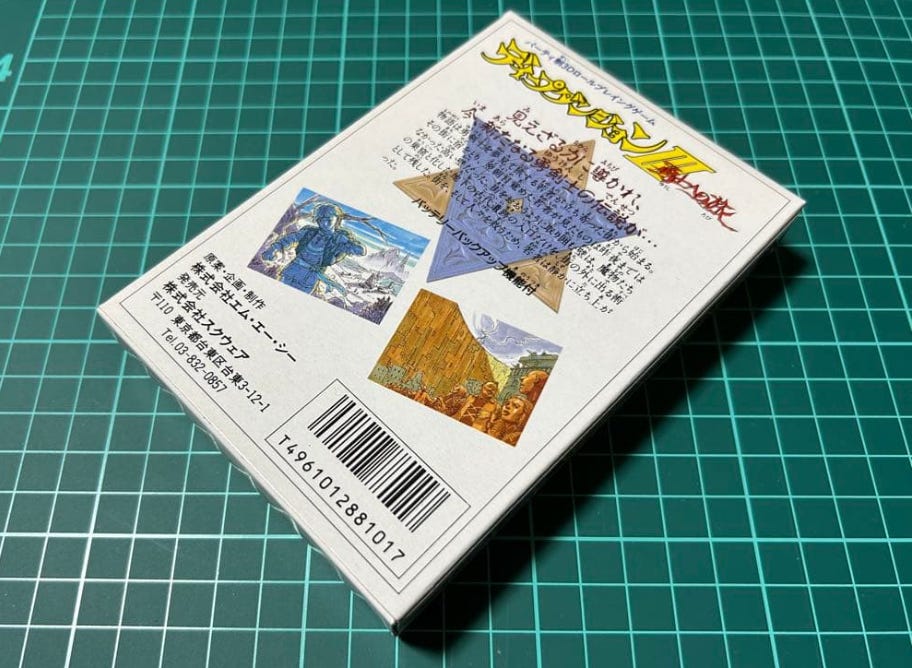
The seller notes that the box has minimal wear or dirt because it was kept inside a master shipping carton. Even when Famicom games remain unopened, decades of storage frequently cause cardboard fading, discoloration, crushed corners, or surface grime—so “unopened” does not automatically mean mint.
From the listing photos, this copy stands out for its clean print colors and lack of obvious crushing or sun damage. Of course, verifying whether a Famicom box has never been opened requires carefully inspecting the side flaps, tabs, and fold lines for any creasing or handling marks. Photos also cannot reveal microscopic flaws or definitively prove carton storage. While 100% unopened status cannot be guaranteed from pictures alone, the exterior presentation is impressive.
The Verdict: Cop or Pass?
As a well-preserved unopened Famicom box, this listing is undeniably tempting. Still, if you ask whether I would drop ¥7,999 to buy it again, the answer is a pass.
I already beat the game back in the day and made peace with what it is, so I have no urge to play through it a second time. More importantly, finding this listing got me wondering whatever happened to my original cartridge and strategy guide. I might have tossed them during a move years ago, or they might still be tucked away somewhere in the house.
Stumbling across this listing brought back so many memories. At the end of the day, I have zero regrets about buying that game and guide together over 30 years ago, but I also have no reason to buy it twice. Right now, I would rather hunt down my old copy than add a new one to the shelf.
Written by Keida| Translated by Lotus
[Market Reality Note] The artifacts featured in our reports are live, highly volatile listings sourced directly from the Japanese domestic secondary market. Due to the underground nature of these collector ecosystems, items may sell out or be removed by the seller at any given moment. Consider each report a real-time window into a vanishing opportunity.
Request Our Premium VIP Hunting Service for Ultra-Rare Vintage Items:
The artifacts exist. The mud is deep.
If you seek a specific Holy Grail in the Japanese underground market and demand our uncompromising vetting process, this private dispatch is available.