
Game Overview
Released for the Super Famicom in 1991, Final Fantasy IV marked a defining turning point for the franchise. By introducing the Active Time Battle (ATB) system, assigning dedicated character jobs, and delivering an emotionally charged story driven by encounters and farewells, it raised narrative standards well beyond earlier entries and left a permanent imprint on the series.
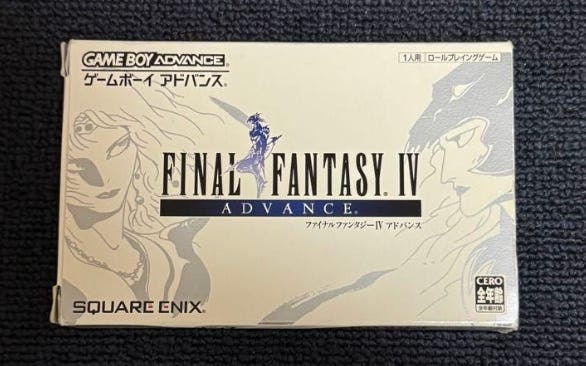
One of its most defining narrative devices was its rotating party. Monk warrior Yang, the bard Edward, the twin mages Palom and Porom, and airship engineer Cid all journeyed alongside Cecil, each playing pivotal roles in the narrative. On the Super Famicom, however, your final five-man party was strictly locked in place.
Every fan wondered at least once what it would be like to carry their favorite companions all the way to the end, or how facing the final boss alongside Cid or Edward might play out. Square Enix finally delivered on that fantasy with the December 15, 2005 release of Final Fantasy IV Advance for the Game Boy Advance.
While rooted in the 16-bit Super Famicom original, the GBA release introduced two major additions. The first and biggest shift was late-game party swapping. Players could finally recruit Yang, Edward, Palom, Porom, and Cid back into their active roster near the climax. In the 1991 original, confronting the final boss, Zeromus, required taking Cecil, Kain, Rosa, Rydia, and Edge. On GBA, players could sub out anyone except Cecil, bringing whichever allies they preferred into the final battle. This was more than a simple quality-of-life update; it gave previously sidelined companions a well-deserved moment of redemption.
To support this freedom, the GBA port introduced two substantial bonus dungeons: the Cave of Trials and the Lunar Ruins. The Cave of Trials rewards returning allies with powerful character-specific gear, giving them the stats they need to survive the endgame. The second postgame challenge, the Lunar Ruins, unlocks only after clearing the main story. Packed with character-specific trials and tough new bosses, it actively encouraged replayability by rewarding players for experimenting with different party combinations. An adventure that ended with the fall of Zeromus on the Super Famicom stretched much further on the GBA.
These additions resonated strongly with the community upon launch. In December 2005, Japanese online forums were filled with players sharing strategies for the Lunar Ruins and comparing notes on character-exclusive gear. Retrospective reviews from 2007 echoed this sentiment, framing party swapping as the long-awaited realization of a dream dating back to the SFC era. Giving players the freedom to build their dream team and tackle new endgame challenges gave this port lasting appeal.
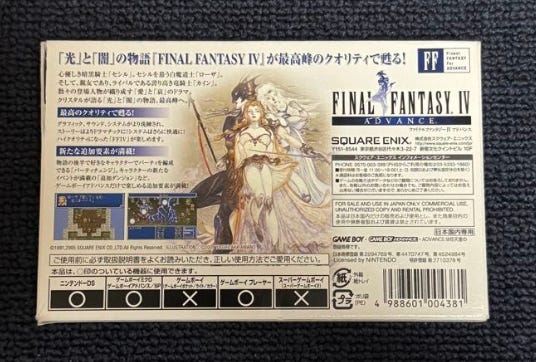
Beyond expanded content, however, Final Fantasy IV Advance holds another distinct claim to fame among dedicated retro collectors: a crucial difference between its initial release and a subsequent revised print. First-print Japanese cartridges suffered from notorious programming bugs, particularly with combat ATB turn orders and equipment logic. For seasoned FFIV veterans, the combat turn-order issues were hard to overlook. While party swapping and new dungeons were welcome, bugged combat sequences hindered an otherwise solid experience.
Following launch, word of these bugs spread across Japanese gaming boards. By 2006, Square Enix quietly distributed an updated revision that resolved core gameplay issues, meaning two distinct versions of the Japanese cartridge were now in circulation.
The two prints are distinguished entirely by small stamps on the cartridge label. The initial buggy run is known as E3, while the patched revision is designated as E4. Because both prints share identical retail packaging and box art, looking at the box alone tells you nothing about which internal ROM build you are buying.
On November 15, 2006, a Japanese blogger documented the arrival of the E4 print, noting that while the first print bore an imprint reading “19 · E3,” the revised cartridge was stamped “19A · E4,” alongside a breakdown of corrected bugs. By March 2007, Q&A threads on Yahoo! Chiebukuro highlighted community advice warning buyers that sealed retail stock could still hold first-print inventory, urging collectors to verify physical label stamps whenever possible. Because the internal revision was completely hidden behind identical retail packaging, buyers had no idea which software build was inside until they inspected the cartridge directly.
The patched E4 release irons out the bulk of the issues that plagued early prints. While bonus dungeons and party swapping remain accessible on E3, players looking for a smooth, glitch-free playthrough prioritize E4. In today’s secondary market, that mechanical stability creates a huge valuation gap between the two prints.
Standard E3 copies typically sell for a few thousand yen. In contrast, verified loose E4 cartridges command prices pushing into the upper 10,000s of yen, with complete boxed copies routinely clearing ¥20,000. It is a prime example of a premium driven not by variant packaging or limited pack-ins, but by the physical preservation of a patched codebase.
Listing Breakdown & Analysis
Item Link: https://buyee.jp/paypayfleamarket/item/z663024524
Price: ¥30,000 (approx. 195–200 USD, tax and domestic shipping included)
Condition: Pre-owned (Cartridge only; “Scratches and dirt”); tested and boot-verified
Notes: Advertised specifically as the patched E4 version. Box and instruction manual are not included.
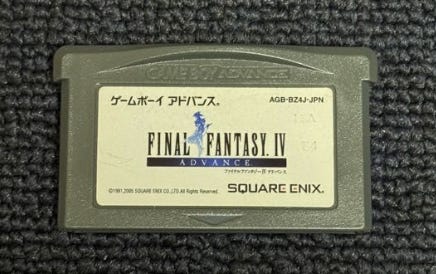
The defining draw of this listing is the explicit claim that it is the patched E4 variant. With verified complete sets exceeding ¥20,000, unboxed E4 units already trade well above baseline E3 carts.
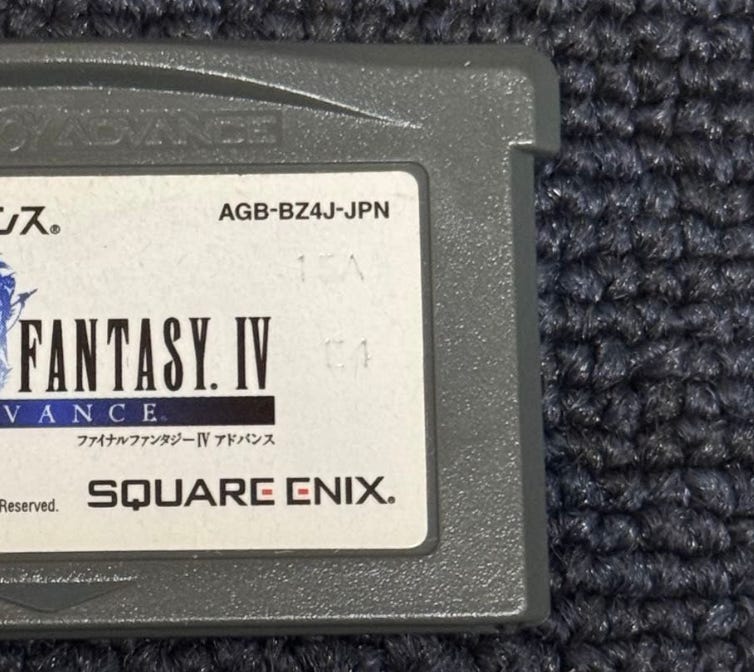
Examining the photos closely, a two-tier stamp is visible on the right side of the front label: the upper row reads “15A” and the lower row reads “E4”. While launch-era documentation commonly referenced “19A · E4,” records dating back to 2011 recognize “15A · E4” production stamps as genuine patched revisions. The visible imprint lines up cleanly with established collector databases, providing strong visual backing for the seller’s claim.
While the seller confirms basic operation, the description is minimal. It remains unconfirmed whether testing went beyond initial boot-up to verify SRAM save retention or stability in postgame areas. Given the official cosmetic grading of “scratches and dirt,” preservation quality requires a measured look.
Cosmetically, the front label exhibits light scuffs and noticeable signs of handling, but the title typography and domestic product code AGB-BZ4J-JPN remain sharp without tearing or heavy peel. The grey plastic shell has minor surface wear, yet photos reveal no deep cracks, corner chips, or missing casing segments.
The rear casing retains its factory tri-wing security screw, and the shell molding matches standard OEM contours. However, screw presence alone cannot confirm whether the cartridge was opened previously, and internal board photos are not provided. While the exterior shows no obvious bootleg tells, visual inspection alone cannot definitively guarantee board authenticity.
The presence of the visible “E4” stamp, label clarity, and shell condition serve as the main positive factors here. However, unverified internal circuitry, basic operational verification, and the total lack of box and manual weigh down its collector profile. Because complete paperwork heavily dictates retro pricing, paying ¥30,000 warrants reaching out to confirm the scope of testing before pulling the trigger.
At ¥30,000, this loose cartridge is priced on the higher end of the E4 market spectrum. Complete-in-box E4 sets have changed hands in the low-to-mid ¥20,000 range in the past, making a loose cartridge at this price point tough to call an outright bargain.
This listing makes sense primarily for dedicated variant hunters who want physical proof of Nintendo and Square’s Japanese revision history. For collectors who already own an E3 print and specifically want a verified E4 cart on hand, paying a markup to secure that specific stamp can be justified.
Final Verdict
The current assessment stands at consideration with conditions. The visible “15A · E4” imprint aligns with verified archival records, giving the listing genuine merit. However, ¥30,000 remains steep for a loose copy with limited testing details. Reaching out to confirm save functionality and overall play stability is recommended before committing.
If your primary goal is simply replaying FFIV on original hardware, passing on this listing is the sensible route; paying ¥30,000 strictly to dodge turn-order bugs is hard to defend, and collectors seeking a complete boxed set will find better value holding out for a full package. This specific cartridge is meant for the enthusiast who values owning a tangible piece of Square’s patching history over everyday play value.
Written by Tanaka | Translated by Lotus
[Market Reality Note] The artifacts featured in our reports are live, highly volatile listings sourced directly from the Japanese domestic secondary market. Due to the underground nature of these collector ecosystems, items may sell out or be removed by the seller at any given moment. Consider each report a real-time window into a vanishing opportunity.
Request Our Premium VIP Hunting Service for Ultra-Rare Vintage Items:
The artifacts exist. The mud is deep.
If you seek a specific Holy Grail in the Japanese underground market and demand our uncompromising vetting process, this private dispatch is available.