
“GaiaSeed” is a horizontal-scrolling shoot-’em-up (shmup) for the PS1, released by Techno Soleil on December 13, 1996. Its official title is “GAIASEED - PROJECT SEED TRAP.” The product code is SLPS-00624, and it originally retailed for 5,800 JPY (excluding tax). The publisher, Techno Soleil, was primarily a system package development company, making this title their very first—and highly unorthodox—foray into the home console gaming space.
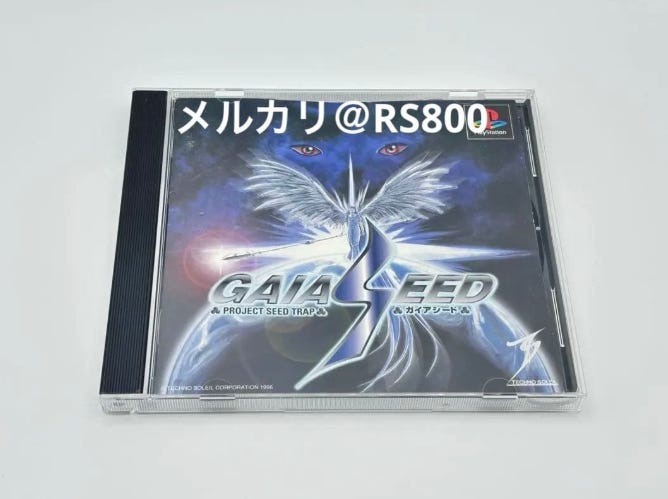
The narrative unfolds in a distant future where a massive machine intelligence known as “GaiaSeed” regulates both Earth’s environment and human civilization. A century prior, an old prototype unit named Uranus was ejected into deep space following a research accident. As Uranus unexpectedly drifts back toward Earth, humanity authorizes the deployment of Adamas—a remote-guided, self-repairing tactical weapon—to intercept and destroy it. Players step into the mind of Cronus, a young man selected as the virtual pilot due to his exceptional sensory synchronization. Across 7 horizontal-scrolling stages, the game features a multi-ending narrative architecture where your actions mid-flight branch out into 3 distinct endings. Structurally, it is uniquely defined by its adoption of a dedicated health gauge system—a rarity for 90s side-scrolling shmups—meaning a single hit does not result in instant death.
What the community holds in the highest regard is the game’s world-building and sound design. Opening with an evocative, poetic cinematic sequence, the BGM composed by Naoto Ishikawa (who later contributed to Otomedius) is of exceptionally high caliber. The Stage 1 track, “Zimetsu Minzoku” (Self-Destructing Race), is still celebrated among fans as an absolute masterpiece of console audio. Conversely, public opinion remains polarized regarding its unpolished visual graphics and heavy aesthetic homages to rival shmups. Yet, rather than fading into the darkness of history as just another obscure release, it has cemented its legacy as a cult classic defined by unmistakable artistic merits and distinct characteristics.
Techno Soleil released a few more titles for the PS1 before quietly exiting the game development industry following the release of TALL TWINS TOWER in November 2000. Today, all 4 software titles published by the company are notoriously difficult to acquire on the secondary market and command extreme premium prices. GaiaSeed stands at the very apex of this lineup, consistently worshipped alongside Cotton 100%, Kyuiin, and Harmful Park as part of the “Holy Grail” tier of impossibly rare PS1 shmups. In the current used market, prices for a copy with the original box and manual have skyrocketed to between 40,000 and 60,000 JPY. The extremely limited production run by an unknown developer directly translates to its insane modern-day scarcity.
Salvaging from the Mud: Profiling a Playable Artifact (Obi Missing, Value Intact)
Target URL: https://buyee.jp/mercari/item/m76395385502
Condition Profile:
Box, manual, and disc are included.
Obi (spine card) and registration postcard are missing.
Zero visible scratches on the disc surface.
Instruction manual shows minor handling wear, but remains in beautiful condition considering its age.
The jewel case is in solid condition.
Confirmed boot-tested and in working order.
Price: 42,200 JPY
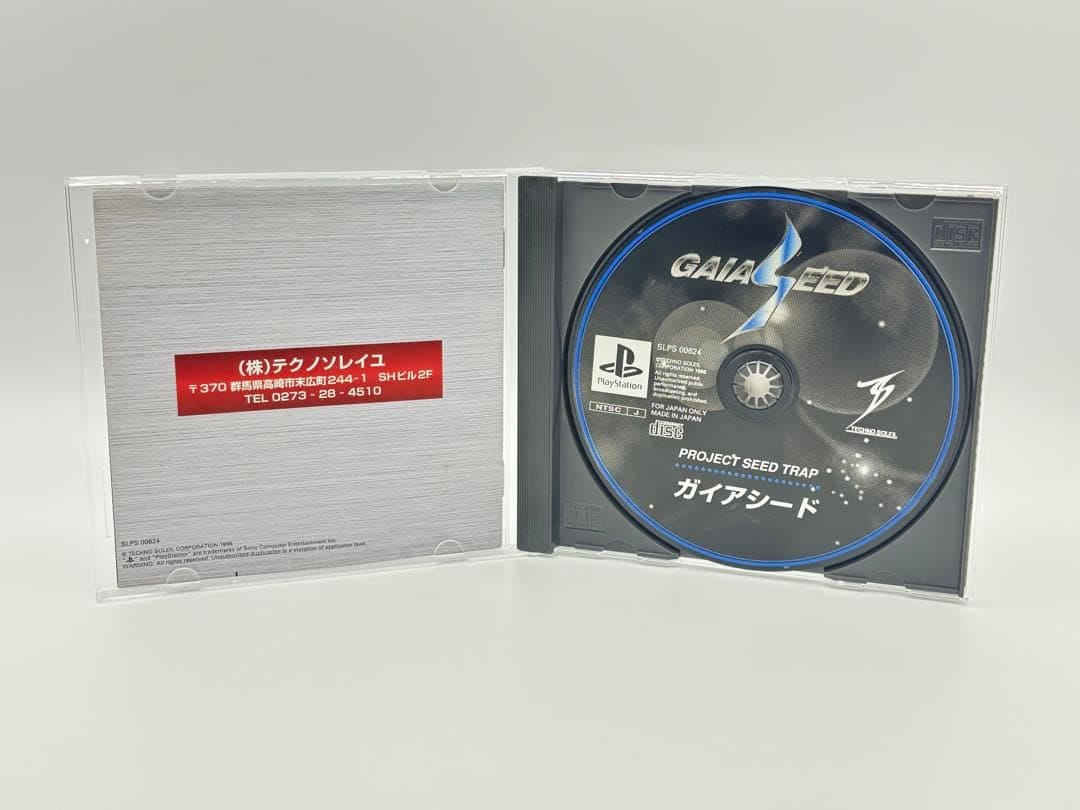
The single most critical factor to evaluate here is the explicit notation that its operation has been verified. For an optical media title released roughly 30 years ago in 1996, the fact that the seller has guaranteed it boots up is a massive factor in mitigating the risk of laser read failures caused by physical aging. Compared to unverified “as-is” junk listings, the difficulty of this gamble drops dramatically.
The physical condition is also at a highly respectable standard. The flawless condition of the optical disc surface is vital; since physical abrasions are the leading cause of read failures, a clean, scratch-free unit offers high operational reliability. While the manual exhibits slight curling, it is completely free of ink stains, harsh creases, or tears—representing negligible degradation given the decades that have passed. The well-preserved state of the case further indicates that the item was stored with care by its previous owner.
The primary point of contention is the missing Obi and postcard. Because it lacks these two elements, this unit cannot be classified as a pristine “Complete in Box” (CIB) set for strict archival collectors. However, when benchmarked against complete copies that currently reach up to 60,000 JPY on the secondary market, a confirmed working copy priced at 42,200 JPY without the Obi/postcard represents a fierce market arbitrage. If your acquisition criteria strictly demand full completeness, this won’t meet your conditions. But for those seeking a playable artifact, or if your collecting style tolerates the absence of the paper inserts, the powerful backing of a confirmed working status makes this a target absolutely worth securing.
Written by A_Kotaro
[Market Reality Note] The artifacts featured in our reports are live, highly volatile listings sourced directly from the Japanese domestic secondary market. Due to the underground nature of these collector ecosystems, items may sell out or be removed by the seller at any given moment. Consider each report a real-time window into a vanishing opportunity.
Request Our Premium VIP Hunting Service for Ultra-Rare Vintage Items:
The artifacts exist. The mud is deep.
If you seek a specific Holy Grail in the Japanese underground market and demand our uncompromising vetting process, this private dispatch is available.