
Whenever I see an unopened Famicom copy of Raid on Bungeling Bay on Mercari, it takes me straight back to the day I bought my first Famicom console.
Over forty years ago, the Famicom boom was at its absolute peak. Retail shelves were constantly cleared out. Even when fresh inventory finally arrived, stores almost always forced bundle deals, tying the sought-after console to less popular software.
When I finally managed to secure a system, it was sold alongside two bundled cartridges. One of those games was Raid on Bungeling Bay.
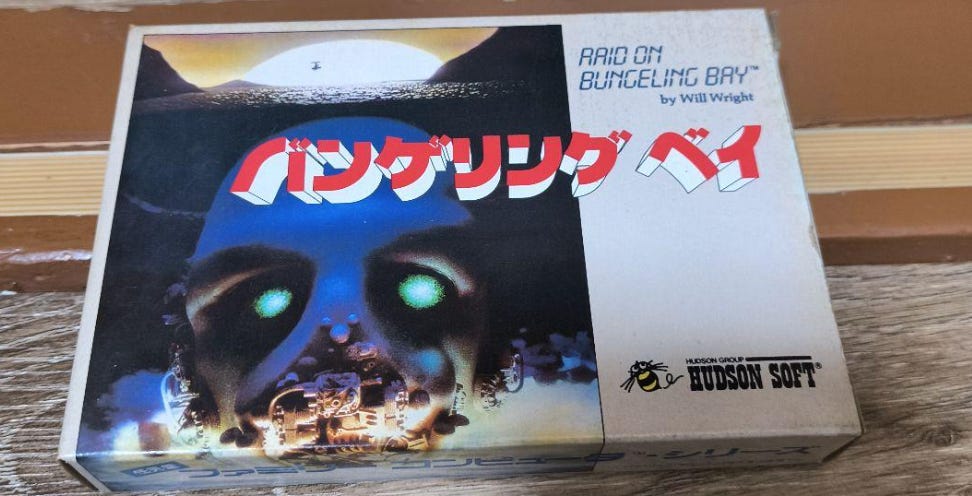
To be completely honest, I didn’t expect much from it at first. If memory serves me correctly, the gaming magazines back then didn’t give it very high marks either.
Once I actually started playing, though, all my doubts instantly vanished. Bombing enemy factories and dogfighting against incoming fighters and battleships delivered a unique style of gameplay. It was far from an easy game, but I was completely hooked. Before I knew it, a title forced on me had turned into a cherished cartridge.
As years passed, just like with my copies of Dragon Quest, I eventually handed Bungeling Bay down to younger relatives.
Time went on. Around ten years ago, I spotted a loose copy of Bungeling Bay at a retro shop in Akihabara. The price tag was cheap, and I bought it without a second thought.
Looking back, maybe I wasn’t just trying to buy the game itself. I was chasing the memory of that entire era—the 80s console shortages, the forced retail bundles, and the unexpected joy of discovering an incredible game.
When I got home, I hooked up my Famicom to an LCD flat screen and fired it up.
Something felt off. It was unmistakably Bungeling Bay. The gameplay hadn’t changed at all. Yet, that feeling from childhood never returned.
I was left wondering whether nostalgia goggles had played tricks on my memory, or if I had simply grown out of it.
After thinking it over for a while, a realization hit me. Back in the day, I never played the Famicom on a crystal-clear LCD display. I played on a heavy CRT television.
Remembering an old CRT still sitting in my parents’ home, I packed up my console and the cartridge a few days later and plugged it in.
To my surprise, the moment the title screen illuminated the glass, the memories came rushing back all at once. What was missing on the LCD screen was right there: the distinct, warm color rendition of cathode-ray tubes, the soft bleed across scanlines and pixel edges, and the gentle, organic look of the whole display. Above all, it brought back the vivid memory of sitting inches from the screen for hours after first bringing the console home.
Of course, CRTs were far from perfect. Geometry warped around the edges. Poor brightness settings strained your eyes, and plenty of us remember walking away from marathon sessions with aching vision.
Even so, we parked ourselves directly in front of that tube and lost all track of time. For me, a CRT monitor isn’t just a display device; it was an inseparable part of how that era’s gaming experience was forged.
What I bought in Akihabara was a single copy of Bungeling Bay. But what I was truly searching for was the kid sitting on the other side of that cathode glass, totally lost in the game.
Seeing this factory-sealed copy on Mercari today, it feels less like software and more like a time capsule waiting to be opened.
Listing Breakdown
Item Link: https://buyee.jp/mercari/item/m33197335925
Price: ¥6,500 (approx. $43 USD)
Condition: Brand New / Unopened (Factory sealed / deadstock; cosmetic age fading and sticker removal residue on outer packaging)
The value of retro gaming relics isn’t measured solely by showroom perfection. In many ways, the slightly sun-faded box in this listing carries its own appeal, serving as tangible proof that this piece survived the height of the original Famicom craze.
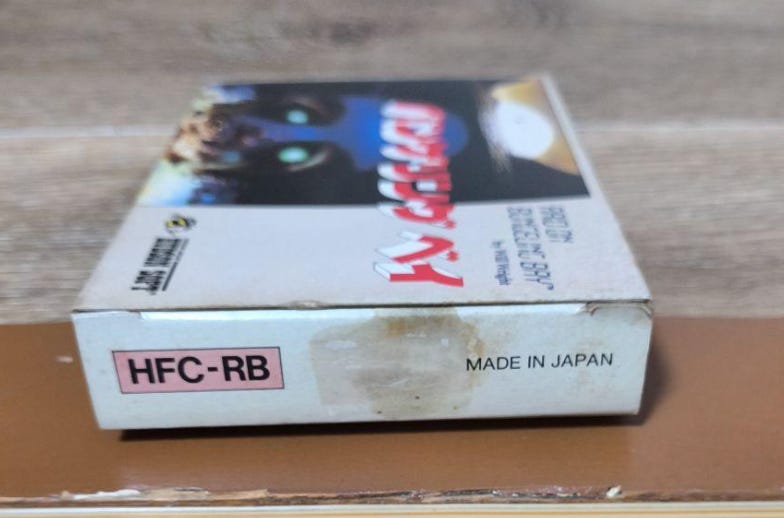
This copy is no exception. During the Famicom era, retailers frequently slapped new price tags over slow-moving stock or peeled stickers off to discount titles in bargain bins. The adhesive residue visible on the packaging likely occurred somewhere along that original retail distribution chain.
Still, judging by the crisp structure of the cardboard, it presents strong credibility as a genuine unopened survivor. The slight discoloration and sticker marks are part of the cartridge’s history.
Written by Keida | Translated by Lotus
[Market Reality Note] The artifacts featured in our reports are live, highly volatile listings sourced directly from the Japanese domestic secondary market. Due to the underground nature of these collector ecosystems, items may sell out or be removed by the seller at any given moment. Consider each report a real-time window into a vanishing opportunity.
Request Our Premium VIP Hunting Service for Ultra-Rare Vintage Items:
The artifacts exist. The mud is deep.
If you seek a specific Holy Grail in the Japanese underground market and demand our uncompromising vetting process, this private dispatch is available.