
Game Overview
Milano’s Odd Job Collection (Milano no Baito Collection) is a cozy game developed by Westone Bit Entertainment and published by Victor Company of Japan. It was released for the Sony PlayStation on July 1, 1999, with an original MSRP of ¥5,800 (approx. $37 USD).
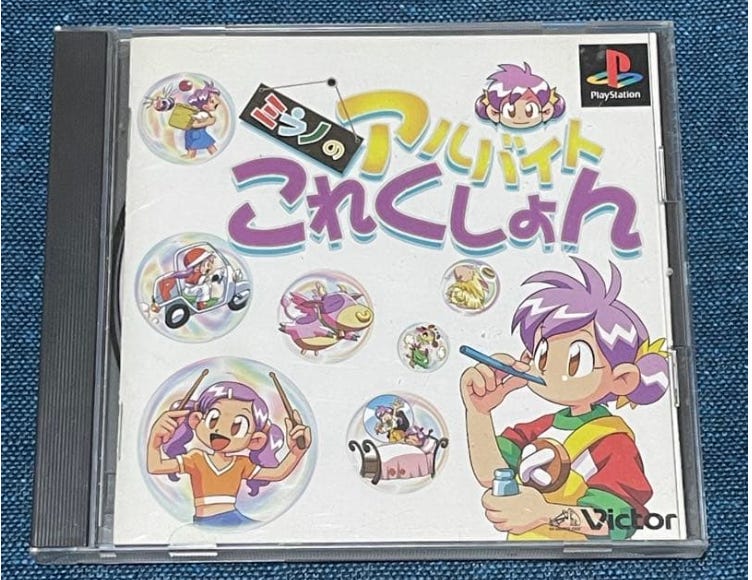
What was meant to be a carefree summer takes an abrupt detour when 11-year-old Milano’s mother is hospitalized, sending her off to stay with her uncle. To her surprise, she arrives only to find an empty house; her uncle has left on vacation. With nothing but 40 long summer days ahead of her, the young girl takes on odd jobs across town to fund her unexpected season of solo living. The game features eight distinct jobs as minigames, each built with completely independent visual styles and control mechanics. You will weave through streets on a scooter for pizza deliveries, step into nurse scrubs to care for clinic patients, milk whimsical flying cows, catch falling fruit, and scrub stacks of dirty dishes.
You cannot talk about this game without mentioning its exceptional pixel art quality. The fluid frame-by-frame character animations, intricate background details designed exclusively for each minigame, and Milano’s expressive sprite designs stand out remarkably for a modest 1999 production. Over the years, retrospective gameplay clips frequently catch retro gaming communities completely off guard with how smooth the 2D work looks.
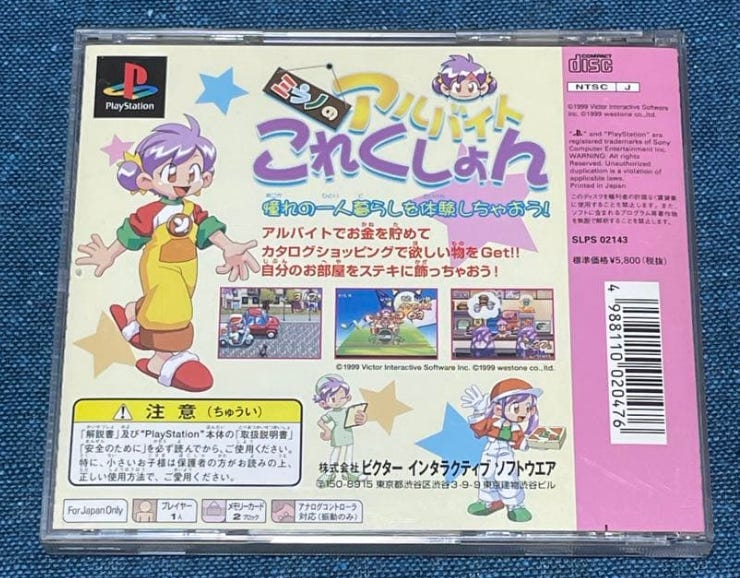
Back in 1999, when the domestic Japanese gaming scene was pivoting aggressively toward 3D polygon engines, this title was an oddity. Yet as one of the final showcases summarizing ‘90s sprite craftsmanship, it achieved some of the finest 2D pixel work on the platform.
The primary reason behind its premium price in the second-hand market is scarce circulation. Arriving in mid-1999, the PlayStation was already entering its twilight years, with gamer and publisher attention rapidly turning toward the upcoming PlayStation 2. Released as a niche title aimed at younger audiences, print runs were extremely small, and few copies survive in clean condition today. In Japan’s current retro market, a complete copy with both the spine card (obi) and registration postcard trades around ¥18,000 (approx. $115 USD), while copies missing inserts still hover around the ¥10,000 (approx. $65 USD) baseline.
On December 9, 2025, the game received a worldwide English port on PC and modern consoles via XSEED Games. Reception was overwhelmingly positive, boasting a 97% positive user rating on Steam. Media outlets widely praised the initiative for making an obscure Japanese retro gem globally accessible, dubbing it an overlooked cult classic from Japan. This newfound recognition naturally directed fresh attention back toward the 1999 PS1 original, sparking a wave of international collectors hunting down physical first-print copies.
Listing Analysis
Item Link: https://buyee.jp/mercari/item/m80514189022
Price: ¥14,000 (approx. 90–95 USD)
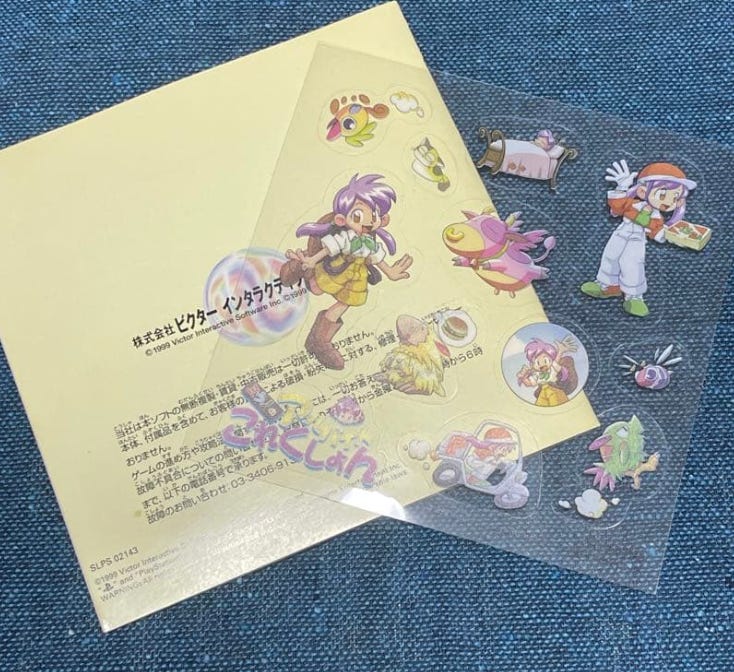
Condition: Case, Manual, Disc & Original Sticker Sheet Included (Spine card / obi and registration postcard missing)
Notes: Operational status unverified. Disc surface is scratch-free. Manual shows no noticeable stains or major blemishes.
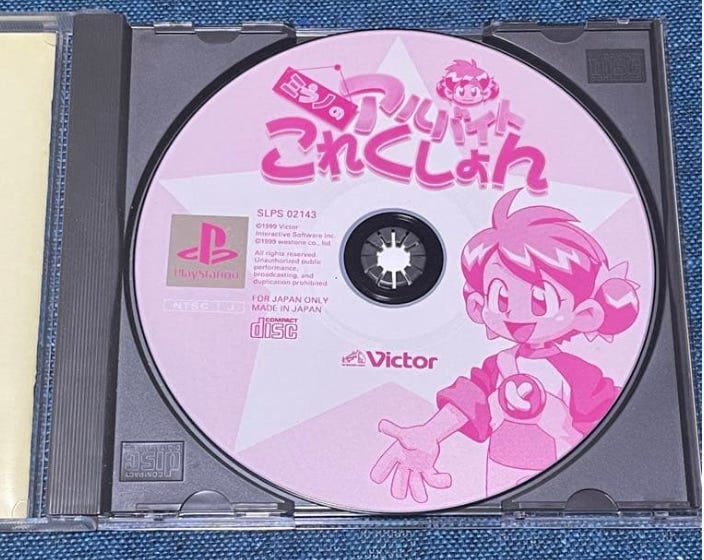
Missing both the spine card (obi) and registration postcard, this copy cannot be graded as a true CIB set, naturally lowering its valuation. On top of that, the seller makes no mention of boot testing. For a PS1 disc that is over 25 years old, visual inspection alone cannot guarantee laser read stability, meaning the operational risk falls squarely on the buyer.
However, there is a compelling detail that offsets this risk: the inclusion of the original bonus sticker sheet. The stickers packaged with this release were almost always peeled and misplaced once a copy was opened and played back in the day. Surviving stickers carry a considerable premium on the retro market. More importantly, the fact that loose paper stickers survived intact strongly suggests this copy was handled with exceptional care.
The seller’s claim that the game was played only once and kept in dark indoor storage lines up well with the physical condition. The disc reading surface shows no visible scratching, and the manual remains clean without notable grime. If the copy was genuinely only played once, laser wear and handling stress would be minimal, making successful boot playback reasonably likely. The fact that it hasn’t changed hands multiple times is another big plus.
At ¥14,000, buying an unverified copy missing its obi and postcard is by no means a risk-free transaction. However, given the clean disc and manual alongside the rare surviving stickers, the asking price has solid justification. With global interest in the PS1 original still riding high following the recent remaster, this copy stands out as a worthwhile pickup for collectors willing to embrace a calculated risk.
Written by A_Kotarou | Translated by Lotus
[Market Reality Note] The artifacts featured in our reports are live, highly volatile listings sourced directly from the Japanese domestic secondary market. Due to the underground nature of these collector ecosystems, items may sell out or be removed by the seller at any given moment. Consider each report a real-time window into a vanishing opportunity.
Request Our Premium VIP Hunting Service for Ultra-Rare Vintage Items:
The artifacts exist. The mud is deep.
If you seek a specific Holy Grail in the Japanese underground market and demand our uncompromising vetting process, this private dispatch is available.