
Game Overview
Kaettekita Cyborg Kuro-chan (帰ってきたサイボーグクロちゃん — literally Cyborg Kuro-chan Came Back) is a side-scrolling run-and-gun action game released by Konami for the PlayStation on November 28, 2002 (Model ID: SLPM-87174, original MSRP: ¥3,900 before tax). Never released in North America or Europe, it remains a Japan-exclusive title.
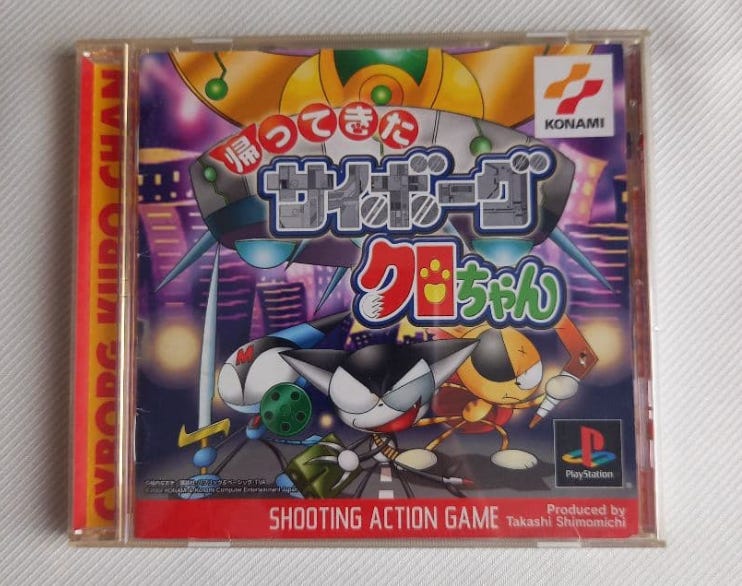
The “Came Back” in the title carries specific context. The original Cyborg Kuro-chan manga was serialized in Kodansha’s Monthly Comic BomBom for over four years, from September 1997 to December 2001. Comic BomBom was a major boys’ manga magazine beloved by Japanese kids throughout the ‘90s and early 2000s. Cyborg Kuro-chan, in particular, was treated on par with a flagship series. As one of the magazine’s few completely original IPs, it had enough presence to make guest appearances in other running series. The manga is an action-comedy centered around Kuro, a black cat turned into an armed cyborg by the mad scientist Dr. Go. From October 1999 to January 2001, the franchise even spawned a 66-episode anime adaptation, running longer than originally planned due to unexpected popularity.
Roughly a year after the manga wrapped up, Konami brought the series back in late 2002 under the Kaettekita banner. At the time, however, the industry had already transitioned to the PlayStation 2. Thus, the title was released on aging PS1 hardware while next-gen consoles dominated store shelves. Paired with a budget-adjacent ¥3,900 price point, it is clear that this was not a major tentpole release. Naturally, initial print numbers were small, directly fueling its scarcity today.
Gameplay lets you pick from three playable characters—Kuro, Mii, and Matatabi—and fight through six side-scrolling stages. During each stage, you come across Power-Up Capsules that can be used to upgrade six different weapons. It also offers two-player simultaneous co-op. Above all, the biggest selling point is full voice acting featuring the original anime cast reprising their roles for the main trio. Additionally, Matatabi was made playable for the first time. Because he was absent from the playable roster in the previous two entries of the franchise, his entry was a welcome touch for fans.
The title, however, received lukewarm reviews from a purely mechanical standpoint. Clunky controls, uneven weapon balancing, and a short six-stage campaign drew criticism, with some noting it missed the chaotic charm of the source material. Still, Konami’s underlying action design fundamentals remain intact beneath the rough edges.
Nonetheless, its values on the second-hand market have blown past the original retail price. Complete boxed copies with manuals currently trade around ¥30,000 (~195–200 USD). Having climbed steadily from the ¥20,000 range in 2025, it continues to hold a spot near the top of PS1 collector price rankings. Its low original print run and Japan-exclusive status remain the core drivers keeping prices high.
Listing Analysis
Item Link: https://buyee.jp/mercari/item/m57539359757
Price: ¥24,999 (approx. $165 USD)
Condition: Case, Manual & Disc Included (Spine card / obi missing; operational status unverified)
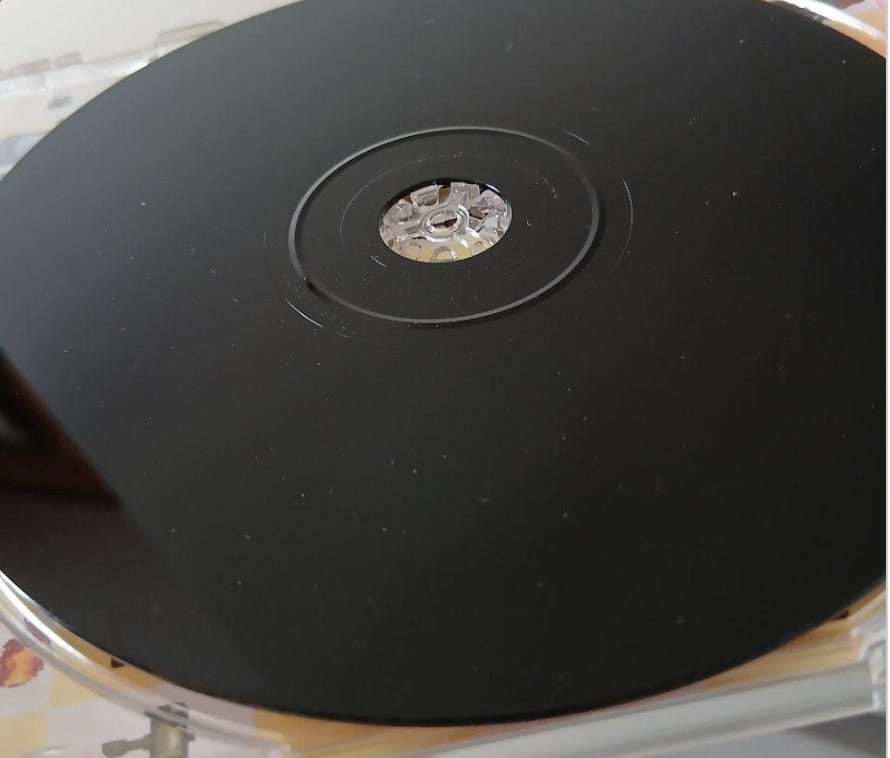
Notes: Jewel case shows light surface scuffs; manual exhibits mild fading. Disc reading surface appears scratch-free. No mention of boot testing in the listing description.
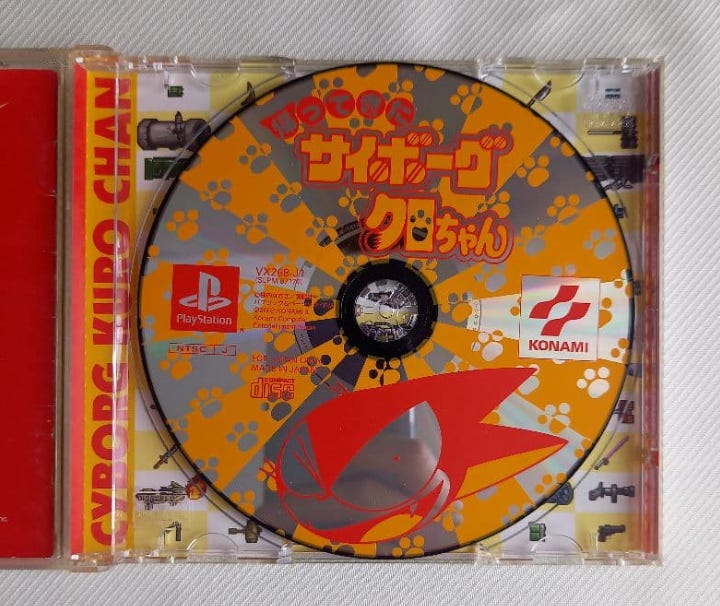
The primary risk factor here is the lack of operational verification. With over 20 years having passed since its 2002 launch, internal disc degradation can cause read errors even when an optical disc looks clean on the outside. Because this is listed as untested, buyers must factor in the possibility that the game may not boot.
On the positive side, the disc surface shows no visible scratches. Since physical surface scuffs are the leading cause of PS1 laser read failures, a clean disc carries solid odds of booting properly. There are no major cracks on the jewel case, and the manual remains in respectable shape, suggesting the copy was stored carefully rather than tossed around. While the surface scuffs and slight manual fading are minor deductions, the overall physical condition grades out well.
The biggest talking point here is the missing spine card. On a title where boxed sets hover around ¥30,000, this copy combines a missing obi with unverified working status. Even considering that tested, obi-less copies realistically land around ¥25,000 to ¥28,000 (~165–185 USD), the untested caveat adds an extra layer of risk. If it boots cleanly, ¥24,999 represents a fair-to-slightly-discounted pickup relative to current market rates. That said, collectors hunting for a 100% complete archive set will need to look elsewhere. This listing makes sense strictly for players or collectors comfortable with an obi-less copy and willing to take a calculated gamble on an untested disc.
Written by A_Kotarou | Translated by Lotus
[Market Reality Note] The artifacts featured in our reports are live, highly volatile listings sourced directly from the Japanese domestic secondary market. Due to the underground nature of these collector ecosystems, items may sell out or be removed by the seller at any given moment. Consider each report a real-time window into a vanishing opportunity.
Request Our Premium VIP Hunting Service for Ultra-Rare Vintage Items:
The artifacts exist. The mud is deep.
If you seek a specific Holy Grail in the Japanese underground market and demand our uncompromising vetting process, this private dispatch is available.