
Game Overview
In 1987, Technos Japan dropped Double Dragon into arcades, setting the blueprint for the emerging beat-’em-up genre. The player takes control of martial artist brothers Billy and Jimmy Lee, punching and kicking their way through city streets. Beyond basic strikes, the ability to grab and throw enemies or weaponize dropped bats and whips made it an instant sensation.
Rather than settling for a straight arcade port, Atlus revived the classic in full force on March 5, 2004, releasing Double Dragon Advance for the Game Boy Advance. It was developed with Paon and S-NEO with an original MSRP of ¥4,800 (¥5,040 with tax).
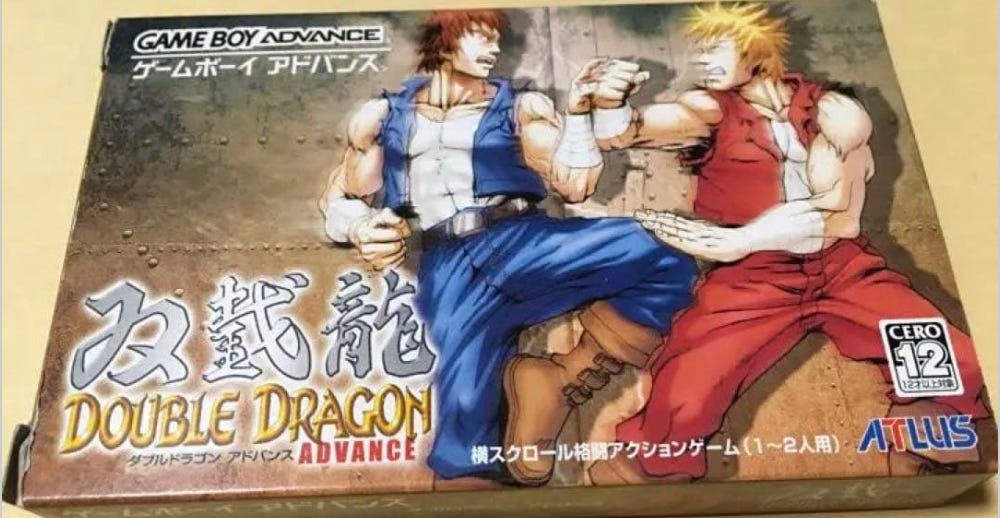
What makes this release stand out is how faithfully it respects the original arcade DNA while blending in various elements across the series. Built on the foundation of the arcade stages and enemy roster, it weaves in mechanics from the Famicom/NES ports and subsequent sequels. With newly added stages, enemies, and techniques, it delivers a fresh gameplay experience that stands apart from the arcade original.
In particular, the combat mechanics received a massive upgrade. Alongside standard strikes and throws, the combat system added combos, parries, and wall-rebound maneuvers. Instead of brainlessly button-mashing through mobs, players have to strategize spacing, time blocks, and combine optimal move strings.
Content-wise, the cart is packed. It features “Double Dragon Mode,” allowing a single player to swap between Billy and Jimmy on the fly. There is also a survival mode in which a player attempts to defeat as many enemies as possible using only a single life. Not only that, Game Link Cable support for arcade-style two-player co-op is supported.
Much of this polish traces back to genuine passion for the original. Planner Muneki Ebinuma posted extensive development logs to fan communities at the time, detailing the core concepts, new stages, and combat adjustments. Approaching the project as dedicated fans first allowed the team to differentiate the homage from ordinary retro re-releases.
Today, Double Dragon Advance commands high interest in global collector circles. On game pricing tracker PriceCharting, Japanese CIB copies hover around $164 USD, while declared “New / Unused” copies sit near $368 USD. Verified sales records show Japanese unplayed copies moving at $367.74 in July 2026 and $324.37 in July 2024, proving consistent high-end demand.
That said, transaction volume for the Japanese release remains relatively thin. A handful of data points does not guarantee an ongoing price surge, nor does an index estimate guarantee future resale prices.
Domestically in Japan, Surugaya listed a standard pre-owned copy at ¥23,900 (approx. $160 USD). While well above its original retail price, individual valuations fluctuate heavily depending on box condition, manual integrity, and paperwork completeness.
Collectors should also take note of the Best Price edition, Best Price: Soshouryu Double Dragon Advance, released on November 26, 2004. If you are buying strictly for archive value, distinguishing between the original 2004 first print and the budget release is essential.
While modern digital ports have made the game accessible on current consoles, holding the original 2004 GBA cartridge and cardboard packaging offers an entirely different appeal. Owning an authentic physical artifact that shows how an 80s arcade giant was reimagined for portable hardware is precisely what drives its collector premium today.
Listing Breakdown
Item Link: https://buyee.jp/mercari/item/m11240493441
Price: ¥75,000 (approx. $500 USD)
Condition: Brand New / Unused (Opened)
Notes: Includes outer box, white inner tray, instruction manual, cartridge in plastic sleeve, and original Club Nintendo registration flyer. Unplayed per seller claim; internals unverified in action.
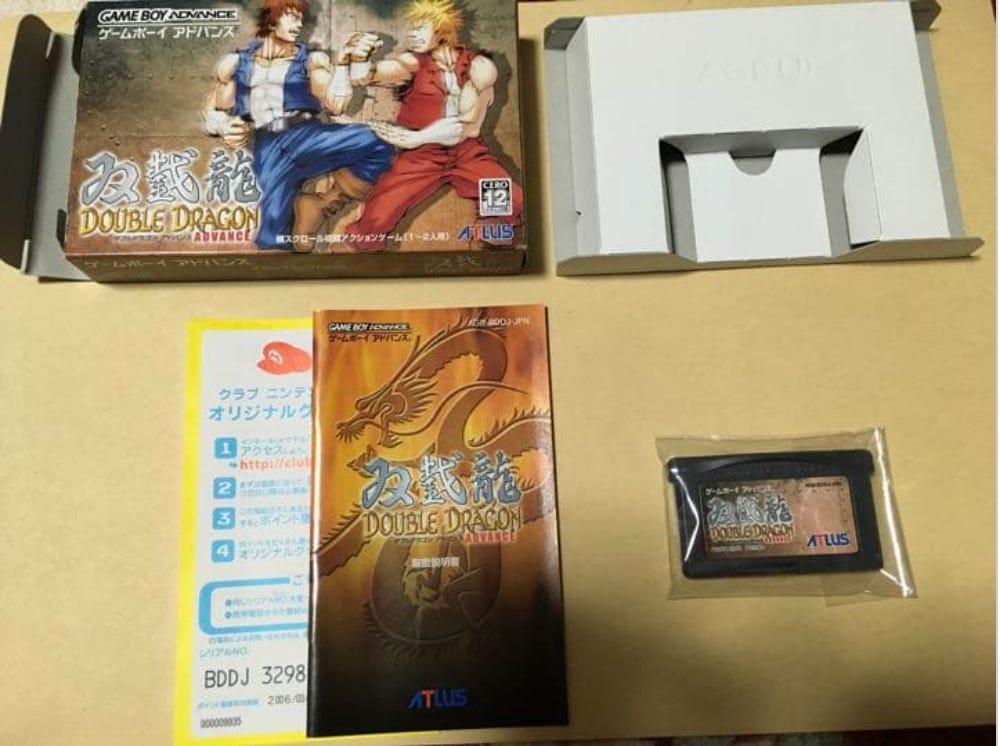
The key discussion point here is that an opened Game Boy Advance game is listed as “Brand New / Unused” for ¥75,000. The seller states the game has never been played since purchase. However, because the box is opened, verifying zero use hours objectively is impossible.
The standout factor is the paperwork. This copy includes the outer box, inner cardboard tray, manual, cartridge, and even the period-correct Club Nintendo registration insert. The cartridge remains tucked inside its protective poly sleeve.
Cosmetically, the front of the outer box looks clean: the artwork featuring Billy and Jimmy Lee along with the title logo retains vivid color without serious fading or staining. The rear print is similarly well-preserved. However, looking closely at the edges reveals corner shelf wear and light surface peeling, alongside handling strain near the opening tab. Overall, it is well-kept but not flawless.
The manual cover shows no severe creasing or edge tears, and the white inner cardboard tray has avoided major crushing. Still, serious buyers should confirm that every piece of original documentation is accounted for.
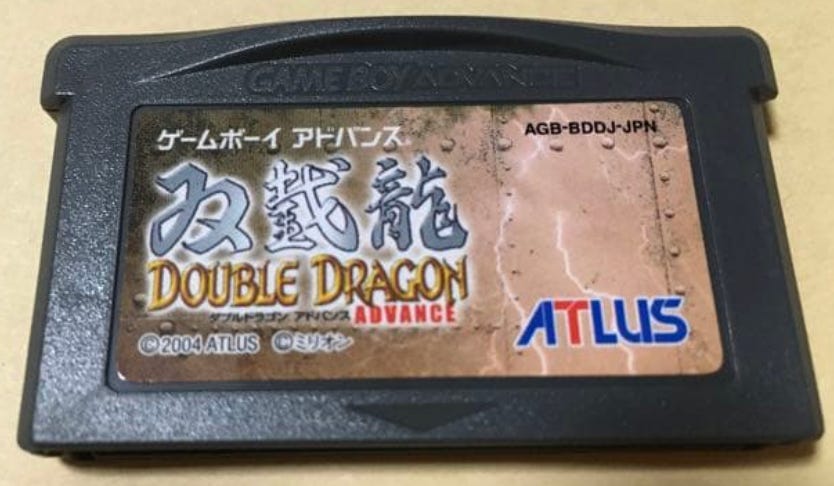
The cartridge face shows the domestic standard release product code AGB-BDDJ-JPN. There is no noticeable peeling on the logo print, and the back displays the Nintendo engraving, model number AGB-002, and retaining screw. While it is consistent with the exterior appearance of an authentic product, the internal circuit board has not been inspected, so authenticity cannot be confirmed.
Additionally, while the seller notes that the marks on the back of the cartridge may have occurred during the manufacturing process, the actual cause remains unknown. Given that the item is claimed to be unused, prospective buyers should also verify whether operational testing has been performed prior to purchasing.
Now for the real question: is ¥75,000 a reasonable asking price? With standard used copies listed around ¥23,900 at Surugaya, this unit demands an approximate 3.1x premium. Even factoring in the complete paperwork and unused claim, the price carries a clear markup.
Looking at PriceCharting, Japanese CIB copies average around $164 USD, with new/sealed copies indexed near $368 USD (backed by completed sales around $367). Because this unit is opened rather than factory sealed, comparing it directly to sealed deadstock is not an exact match.
Final Verdict
Recommended with caution, strictly for collectors who prioritize complete original paperwork and a low-use history over minor outer box wear. While ¥75,000 carries an undeniable markup, finding an unplayed first-print cart with clean manual print and the original Club Nintendo insert intact is genuinely difficult.
If you demand a pristine, unblemished outer box or a copy to pop into an SP and play, passing on this listing is the smarter play. This listing is meant for collectors who specifically want a near-zero-mileage GBA original on display.
Written by Tanaka | Translated by Lotus
[Market Reality Note] The artifacts featured in our reports are live, highly volatile listings sourced directly from the Japanese domestic secondary market. Due to the underground nature of these collector ecosystems, items may sell out or be removed by the seller at any given moment. Consider each report a real-time window into a vanishing opportunity.
Request Our Premium VIP Hunting Service for Ultra-Rare Vintage Items:
The artifacts exist. The mud is deep.
If you seek a specific Holy Grail in the Japanese underground market and demand our uncompromising vetting process, this private dispatch is available.